





aluminum hydroxide to aluminum
The Transformation of Aluminum Hydroxide to Aluminum A Comprehensive Overview
Aluminum is one of the most abundant metals in the Earth's crust, and its utility is extensive, ranging from construction materials to aerospace components. A crucial step in the production of aluminum metal involves the conversion of aluminum hydroxide to aluminum. This process is pivotal not just for industries but also for advancements in technology and sustainability.
Aluminum hydroxide, represented chemically as Al(OH)₃, is a compound formed naturally through the weathering of aluminum-containing rocks. It is commonly found in bauxite, the primary ore of aluminum. When extracted from bauxite, aluminum hydroxide serves as an intermediary in the aluminum extraction process. The conversion of aluminum hydroxide into aluminum metal involves several stages, primarily through a method known as the Bayer process followed by electrolysis.
The Bayer process is employed to refine bauxite into alumina (Al₂O₃). The bauxite ore is first crushed and then mixed with a sodium hydroxide solution. Under high temperature and pressure, the aluminum hydroxide dissolves into the solution, leaving behind impurities. Once the solution cools, aluminum hydroxide precipitates out, and is then filtered and washed to remove residual sodium hydroxide. This purified aluminum hydroxide is then heated to around 1000 to 1100 degrees Celsius in a process known as calcination, where it decomposes to form alumina. The reaction can be summarized as
\[ 2 Al(OH)₃ \rightarrow Al₂O₃ + 3 H₂O \]
aluminum hydroxide to aluminum
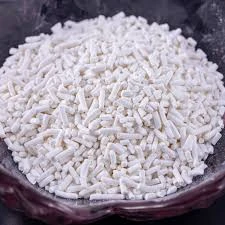
Following the Bayer process, the next phase is the Hall-Héroult process, which is the primary method for extracting aluminum from alumina. In this electrolytic reduction process, alumina is dissolved in molten cryolite (Na₃AlF₆) and subjected to a direct current. This causes the aluminum ions to migrate towards the cathode, where they gain electrons and are reduced to form liquid aluminum. Simultaneously, oxygen is released at the anode. The chemical reactions that occur during this process can be simplified as follows
\[ Al₂O₃ + 3 C \rightarrow 2 Al + 3 CO₂ \]
This transformation from aluminum hydroxide to aluminum is not only significant for the production of aluminum but also has implications for environmental sustainability. The aluminum industry has made notable strides in recycling, as recycled aluminum requires up to 95% less energy compared to primary aluminum production. By utilizing scrap aluminum, manufacturers can reduce the amount of aluminum hydroxide required, thereby decreasing the environmental footprint associated with mining and processing bauxite.
Moreover, advancements in technology have led to more efficient electrolytic cells and improved energy consumption during the aluminum reduction process. Sustainable practices, such as using renewable energy sources for the electrolytic process and improving waste management, are becoming more prevalent, which is essential for the industry's future.
In conclusion, the transformation of aluminum hydroxide to aluminum is a complex but fascinating journey that underscores the importance of aluminum in various applications. As industries continue to evolve and prioritize sustainability, understanding this conversion process becomes ever more relevant, paving the way for innovations that can benefit both the economy and the environment. The aluminum production process illustrates a blend of chemistry, engineering, and environmental stewardship—a true hallmark of modern industrial practice.
-
How to Choose Dimethyl Disulfide DMDS for Industrial UseNewsNov.09,2026
-
Aspartame Buyer FAQ: Sweetness, Specifications and ApplicationsNewsNov.02,2026
-
Aluminum Hydroxide FAQ: Specifications, Ordering and Support QuestionsNewsOct.28,2026
-
Improve Crop Yield with Premium Calcium Boron FertilizerNewsJul.01,2026
-
Ultimate Guide to Cal Mag Fertilizer for Boosting Plant HealthNewsJun.29,2026
-
Maximize Crop Recovery Using High Performance Bounce Back FertilizerNewsJun.27,2026
-
Maximize Crop Yields and Soil Health with Biozyme FertilizerNewsJun.26,2026
Hebei Tenger Chemical Technology Co., Ltd. focuses on the chemical industry and is committed to the export service of chemical raw materials.
-

view more Tplyltriazole(TTA)Tplyltriazole is a powerful and versatile corrosion inhibitor,it is a white particle or powder that is easily hygroscopic and can be processed into large, small, columnar, fine, or powdered shapes.It is a highly effective solution for preventing rust and corrosion on a variety of metal surfaces, making it an ideal choice for a wide range of applications. -

view more Formic AcidFormic acid, is a colorless, pungent-smelling liquid.With its unique properties and diverse applications that serves a wide range of industrial and commercial applications. -

view more Aluminum HydroxideAluminum Hydroxide, a versatile and essential product for a wide range of applications.This product is a white, amorphous powder that is insoluble in water and has a variety of uses in industries such as pharmaceuticals, cosmetics, and manufacturing.