





Production and Processing of Ammonium Bicarbonate in Industrial Settings
The Ammonium Bicarbonate Factory A Key Player in the Chemical Industry
Ammonium bicarbonate, a crucial chemical compound with a wide range of applications, is produced in specialized factories dedicated to its manufacturing. These facilities play a pivotal role in ensuring that this compound is readily available for various industries, including agriculture, food processing, and pharmaceuticals. This article explores the production process, applications, and environmental considerations associated with ammonium bicarbonate factories.
What is Ammonium Bicarbonate?
Ammonium bicarbonate, with the chemical formula NH4HCO3, is an inorganic compound that appears as a white crystalline solid. It is commonly used as a food additive, a leavening agent in baking, and a nitrogen source in fertilizers. The compound is favored in certain agricultural applications due to its ability to provide nitrogen—an essential nutrient for plant growth. Moreover, its ability to decompose into ammonia, carbon dioxide, and water makes it a non-toxic option compared to other nitrogen fertilizers.
Production Process
The manufacturing of ammonium bicarbonate typically involves several key steps, predominantly starting with the reaction between ammonia and carbon dioxide. The process can be summarized as follows
1. Ammonia Production Ammonia, a colorless gas with a distinct smell, is produced primarily via the Haber-Bosch process. This method combines nitrogen from the air with hydrogen derived from natural gas at high pressures and temperatures.
2. Carbon Dioxide Generation Carbon dioxide is often sourced from various industrial processes, including combustion and fermentation. In some factories, specific carbon dioxide capture technologies are used to ensure sustainability and reduce emissions.
3. Reaction Formation Once both ammonia and carbon dioxide are available, they are reacted together in a controlled environment, typically in large reactors. The reaction leads to the formation of ammonium bicarbonate
\[ \text{NH}_3 + \text{CO}_2 + \text{H}_2\text{O} \rightarrow \text{NH}_4\text{HCO}_3 \]
4. Crystallization The ammonium bicarbonate produced is then subjected to crystallization, a process that helps in obtaining the desired purity and particle size. This step is crucial for ensuring that the product meets industry standards.
ammonium bicarbonate factory
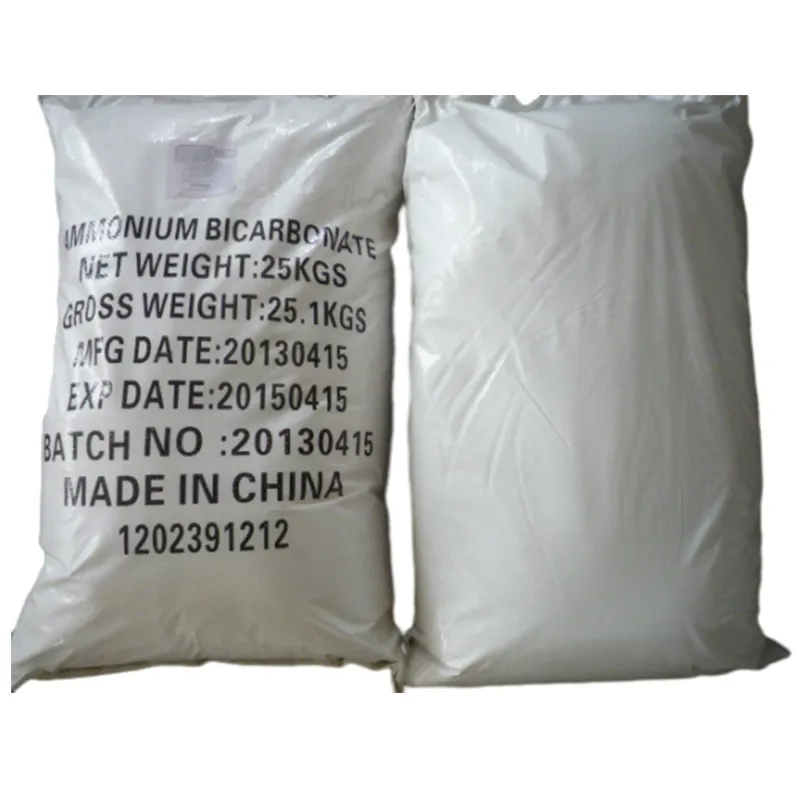
5. Drying and Packaging The final product is dried to remove excess moisture and packaged for distribution. Factories often prioritize eco-friendly packaging materials to align with sustainability initiatives.
Applications
Ammonium bicarbonate finds utility in various sectors
- Agriculture As a nitrogen source, it is widely used in fertilizers. Farmers appreciate its quick-release properties, making it effective for crops that require fast nutrient uptake.
- Food Industry In baking, ammonium bicarbonate acts as a leavening agent, producing carbon dioxide when heated. This reaction helps baked goods achieve a light and airy texture.
- Pharmaceuticals The compound is also used in some pharmaceutical formulations as a buffering agent to stabilize pH levels.
Environmental Considerations
While ammonium bicarbonate is generally regarded as safe, the manufacturing process must take into account environmental impacts. Emissions of ammonia and carbon dioxide during production can contribute to air pollution. As a response, many factories are adopting cleaner technologies and waste management practices to mitigate their ecological footprint.
Moreover, innovation in carbon capture techniques ensures that the carbon dioxide used in manufacturing is sourced sustainably. Emphasizing energy-efficient practices and reducing waste are critical components of modern ammonium bicarbonate production.
Conclusion
The ammonium bicarbonate factory is a vital entity within the chemical industry, serving a crucial function in agriculture, food processing, and pharmaceuticals. Through its manufacturing processes, it provides a versatile compound that supports various sectors while also navigating the challenges of environmental responsibility. Continuous advancements in technology and sustainable practices will further enhance the industry's efficiency and reduce its ecological impact, pointing toward a more sustainable future in chemical manufacturing.
-
How to Choose Dimethyl Disulfide DMDS for Industrial UseNewsNov.09,2026
-
Aspartame Buyer FAQ: Sweetness, Specifications and ApplicationsNewsNov.02,2026
-
Aluminum Hydroxide FAQ: Specifications, Ordering and Support QuestionsNewsOct.28,2026
-
Improve Crop Yield with Premium Calcium Boron FertilizerNewsJul.01,2026
-
Ultimate Guide to Cal Mag Fertilizer for Boosting Plant HealthNewsJun.29,2026
-
Maximize Crop Recovery Using High Performance Bounce Back FertilizerNewsJun.27,2026
-
Maximize Crop Yields and Soil Health with Biozyme FertilizerNewsJun.26,2026
Hebei Tenger Chemical Technology Co., Ltd. focuses on the chemical industry and is committed to the export service of chemical raw materials.
-

view more Tplyltriazole(TTA)Tplyltriazole is a powerful and versatile corrosion inhibitor,it is a white particle or powder that is easily hygroscopic and can be processed into large, small, columnar, fine, or powdered shapes.It is a highly effective solution for preventing rust and corrosion on a variety of metal surfaces, making it an ideal choice for a wide range of applications. -

view more Formic AcidFormic acid, is a colorless, pungent-smelling liquid.With its unique properties and diverse applications that serves a wide range of industrial and commercial applications. -

view more Aluminum HydroxideAluminum Hydroxide, a versatile and essential product for a wide range of applications.This product is a white, amorphous powder that is insoluble in water and has a variety of uses in industries such as pharmaceuticals, cosmetics, and manufacturing.