






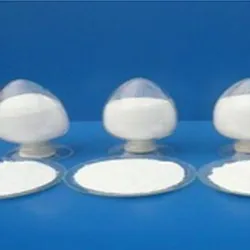
Hydroxyde d'aluminium, un produit polyvalent et indispensable pour une large gamme d'applications. Ce produit est une poudre blanche amorphe insoluble dans l’eau et utilisée dans diverses industries telles que les produits pharmaceutiques, les cosmétiques et la fabrication.
L’une des principales caractéristiques de l’hydroxyde d’aluminium réside dans ses excellentes propriétés ignifuges. Il peut empêcher efficacement la propagation des flammes et est donc largement utilisé dans la fabrication de matériaux ignifuges tels que des fils et câbles, des matériaux de construction et des pièces automobiles. De plus, l'hydroxyde d'aluminium présente également une bonne stabilité thermique et chimique et peut maintenir sa stabilité à des températures élevées et dans des environnements corrosifs. Il est donc largement utilisé dans les industries aérospatiale, chimique et électronique.
En plus de ses propriétés ignifuges, l’hydroxyde d’aluminium possède également de bonnes propriétés de remplissage. Il peut être ajouté comme charge aux plastiques, caoutchoucs et résines pour augmenter leur résistance et leur dureté tout en réduisant les coûts. Cela rend l'hydroxyde d'aluminium largement utilisé dans les produits en plastique, les produits en caoutchouc et les matériaux composites.
En outre, l'hydroxyde d'aluminium possède également de bonnes propriétés hygroscopiques et des propriétés chimiques stables, ce qui en fait une matière première importante pour la préparation de divers produits chimiques et pharmaceutiques. Il est largement utilisé dans la fabrication de matériaux résistants aux acides et aux alcalis, d’intermédiaires pharmaceutiques, de cosmétiques et d’autres produits.
En bref, l'hydroxyde d'aluminium est une matière première chimique multifonctionnelle dotée d'excellentes propriétés ignifuges, de propriétés de remplissage et de stabilité chimique, et convient à de nombreuses industries. Nos produits sont conformes aux normes internationales, ont une qualité fiable et des prix raisonnables. Nous sommes impatients de travailler avec vous pour vous fournir des produits et services d’hydroxyde d’aluminium de haute qualité.
Marque | Al2O3% | SiO2% | Fe2O3% | Na2O% | % de lettre d'intérêt | Humidité | -45um% |
≥ | ≤ | ≤ | ≤ | ≤ | ≤ | ||
HA-H | 64.5 | 0.02 | 0.008 | 0.4 | 34.5±0.7 | 0.1 | 5-10 |
▪ Dans l'industrie pharmaceutique, notre hydroxyde d'aluminium est largement utilisé comme antiacide pour neutraliser l'excès d'acide gastrique et soulager les brûlures d'estomac et l'indigestion.
▪ Dans l'industrie cosmétique, notre hydroxyde d'aluminium est apprécié pour ses propriétés exfoliantes douces, ce qui en fait un ingrédient populaire dans les gommages pour le visage et autres produits de soins de la peau.
▪ Les propriétés ignifuges de l'hydroxyde d'aluminium en font un composant important dans la production et le traitement des câbles, des textiles et des matériaux de construction.
▪ L'hydroxyde d'aluminium est un composant crucial dans la production de céramiques, où il agit comme agent de remplissage et de renforcement, améliorant la résistance et la durabilité des produits céramiques.
▪ L'hydroxyde d'aluminium est également utilisé dans la fabrication du verre, où il agit comme fondant pour abaisser le point de fusion des matières premières, facilitant ainsi la production de produits en verre de haute qualité avec une clarté et une résistance améliorées.
How Does Aluminum Hydroxide Work as a Flame Retardant?
Aluminum hydroxide is widely used as a flame retardant and smoke suppressant in many polymer and composite applications. Its effectiveness comes mainly from its thermal decomposition behavior. When exposed to elevated temperatures, aluminum hydroxide releases water in the form of vapor and undergoes an endothermic decomposition reaction. This process absorbs a significant amount of heat from the surrounding material, helping reduce the temperature of the polymer and slowing down the combustion process.
During decomposition, aluminum hydroxide also produces alumina, which can contribute to the formation of a protective barrier on the surface of the material. This barrier helps reduce heat transfer and limits the contact between the underlying polymer and oxygen. At the same time, the release of water vapor can dilute combustible gases generated during polymer degradation. These combined effects make aluminum hydroxide an effective halogen-free flame-retardant filler.
Understanding how aluminum hydroxide is used is important when developing flame-retardant plastics, rubber products, cables, coatings, and other composite materials. The particle size, purity, surface treatment, and loading level can all influence its performance. Fine grades may provide better dispersion and surface interaction, while specially treated grades can improve compatibility with hydrophobic polymer systems.
Another important consideration is processing temperature. Since aluminum hydroxide begins to decompose at relatively moderate temperatures, material selection should take processing conditions into account. Manufacturers also need to balance flame-retardant performance with mechanical properties and processing characteristics.
From a commercial perspective, aluminum hydroxide cost and aluminum hydroxide price can vary according to purity, particle size, surface modification, production method, and order volume. Therefore, selecting the appropriate grade requires more than simply comparing prices. The relationship between aluminum and hydroxide provides the material with its useful thermal decomposition characteristics, making it an important option for safer, halogen-free formulations.
How to Choose Aluminum Hydroxide for Flame Retardant Applications
Choosing the right aluminum hydroxide for flame-retardant applications requires careful consideration of both technical requirements and production conditions. Although aluminum hydroxide is commonly available in different grades, not every grade provides the same performance in a particular polymer system.
The first factor to consider is purity. High-purity aluminum hydroxide can provide more consistent thermal behavior and reduce the risk of unwanted impurities affecting the final product. Particle size is another important consideration. Smaller particles can improve dispersion and surface contact, while larger particles may sometimes offer advantages in processing efficiency and filler loading. The appropriate particle size depends on the polymer matrix and the required mechanical and flame-retardant properties.
Surface treatment should also be evaluated. Untreated aluminum hydroxide may have limited compatibility with certain hydrophobic polymers. Surface-modified grades can improve dispersion, reduce filler-polymer interfacial problems, and help maintain the mechanical properties of the finished material. Therefore, understanding the intended aluminum hydroxide use is essential before selecting a grade.
Processing temperature is equally important. Because aluminum hydroxide releases water when heated, its thermal stability must be compatible with the processing conditions of the polymer. If the processing temperature is too close to its decomposition range, premature water release may affect production quality.
Cost is another practical factor. Aluminum hydroxide cost is influenced by purity, particle size distribution, surface treatment, manufacturing technology, and purchasing volume. When comparing aluminum hydroxide price, buyers should consider total formulation cost rather than the material price alone. A higher-priced grade may provide better dispersion or allow optimized loading, potentially reducing overall production expenses.
Finally, manufacturers should evaluate the balance between flame-retardant efficiency, mechanical performance, processing behavior, and cost. The chemical combination of aluminum and hydroxide gives this filler its characteristic endothermic decomposition, making it suitable for many halogen-free flame-retardant formulations. Selecting the right grade based on actual application requirements can help achieve reliable performance and consistent product quality.
Benefits of Aluminum Hydroxide as a Filler
Aluminum hydroxide is an important inorganic filler used in plastics, rubber, adhesives, coatings, cables, and composite materials. In addition to its flame-retardant function, it can provide several formulation benefits, making it attractive for manufacturers seeking multifunctional filler solutions.
One of the main advantages is its ability to absorb heat during thermal decomposition. When heated, aluminum hydroxide releases water and forms alumina. This endothermic reaction can help reduce the temperature of the surrounding material and contribute to improved flame resistance. For this reason, aluminum hydroxide use is particularly common in halogen-free flame-retardant systems.
Another benefit is smoke suppression. Compared with some traditional flame-retardant technologies, aluminum hydroxide can help reduce smoke generation in certain polymer formulations. This characteristic can be valuable in applications such as electrical components, construction materials, and transportation-related products where smoke control is an important safety consideration.
Aluminum hydroxide can also serve as a cost-effective mineral filler. Depending on the formulation, it may partially replace more expensive functional additives while maintaining the required performance. However, aluminum hydroxide cost and aluminum hydroxide price vary according to grade, purity, particle size, surface treatment, and supply conditions. Buyers should therefore evaluate both technical performance and total formulation economics.
Another advantage is its halogen-free composition. The combination of aluminum and hydroxide provides a useful mechanism for heat absorption and water release without relying on halogen-containing chemistry. This makes aluminum hydroxide attractive for manufacturers developing more environmentally considerate flame-retardant materials.
The physical characteristics of the filler can also influence processing and final product properties. Properly selected particle size and surface treatment can improve dispersion and compatibility with the polymer matrix. Therefore, the most suitable grade depends on the specific application, resin type, processing method, and required flame-retardant level.
Overall, aluminum hydroxide offers a combination of flame retardancy, smoke suppression, filler functionality, and formulation flexibility. When the appropriate grade is selected, it can help manufacturers develop safer and more economical polymer and composite products.
aluminum and hydroxide
aluminum hydroxide
aluminum hydroxide antacid
aluminum hydroxide dried gel
aluminum hydroxide gel


